
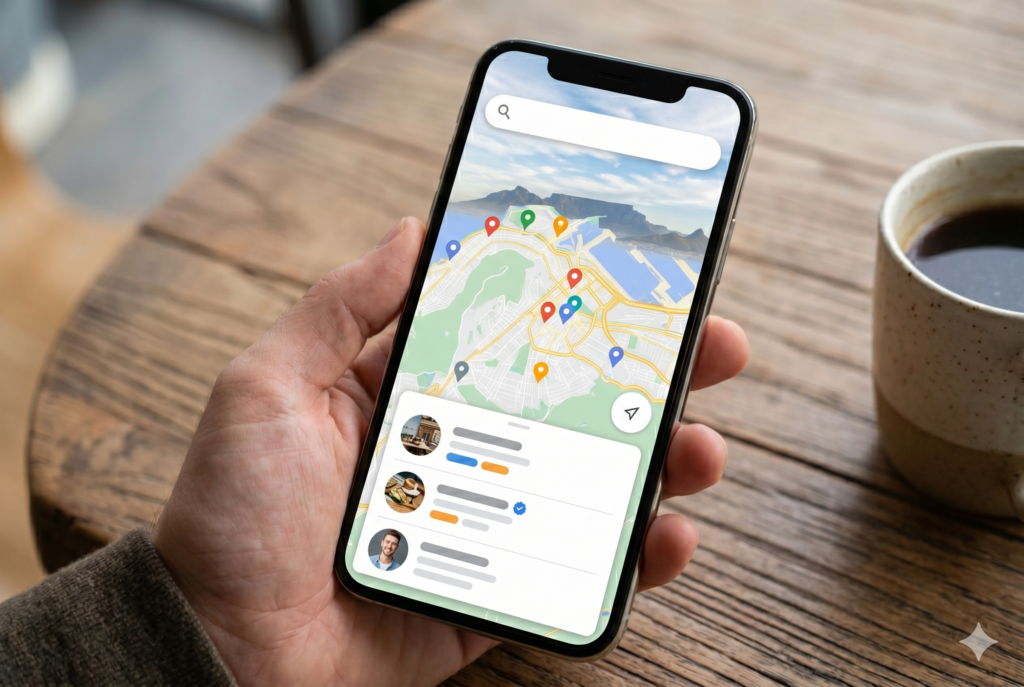
You rank for ‘near me’ searches by sending the correct signals to Google’s local search algorithm. This algorithm prioritises businesses that best satisfy three core factors: proximity to the user, relevance to the search query, and offline prominence.
Structuring your digital presence to align with these pillars is the only method to appear in the Google Maps “3-Pack” for high-intent local customers. The bottom line is that your visibility is determined by data consistency and local authority, not by repeating “near me” on your website.
The Algorithm’s Logic: Proximity, Relevance, and Prominence
Ranking in local search is a direct result of how well your business is understood by Google’s algorithm. This system uses three primary components to organise and rank businesses: proximity, relevance, and prominence. Mastering these elements is fundamental to achieving visibility when a potential customer searches for services in their immediate area.
Proximity as a Hard Filter
Proximity refers to the physical distance between the user’s location and your business address. Google uses GPS data from mobile devices or IP addresses from desktops to determine the user’s location and provide the most geographically convenient options.
While you cannot change your business’s physical location to manipulate this factor, you can ensure its accuracy. An exact address, correctly pinned on Google Maps and consistent across all online platforms, is the foundation of proximity. This is the most rigid of the ranking factors; if your business is not close enough to the searcher, it is unlikely to be considered a good result.
Relevance Through Data Signals
Relevance is how well your online profile matches a user’s search query. The algorithm assesses this by analysing several data points to understand the services you offer and the areas you serve.
- Google Business Profile (GBP) Categories: Selecting the correct primary and secondary business categories on your GBP is a critical signal. Choosing “Plumber” instead of a generic “Contractor” tells Google exactly what you do.
- On-Page Content: Your website content must reinforce your services. If you are a plumber in Durban, your website should have pages that explicitly mention “plumbing services in Durban,” “geyser repair in Umhlanga,” or “blocked drains in Durban North.”
- NAP Consistency: Your business Name, Address, and Phone number (NAP) must be identical across your website, GBP, and all other online directories. Inconsistencies create doubt for the algorithm, weakening its trust in your business’s legitimacy and location.
Prominence From Local Authority
Prominence refers to how well-known and reputable your business is in its local market. Google measures this through various online signals that act as votes of confidence from the local community.
- Customer Reviews: The quantity, velocity, and quality of Google reviews are a powerful prominence signal. Positive reviews that mention specific services and locations reinforce both relevance and authority.
- Local Backlinks: A backlink from a reputable, geographically relevant South African website is a strong endorsement. Links from local news publications, chambers of commerce, or community blogs signal to Google that your business is a trusted part of the local ecosystem.
- Citations: A citation is a mention of your NAP on another website, such as a local business directory. Consistent citations across high-quality South African directories like Yellow Pages, Brabys, and HelloPeter build a portfolio of proof for your business’s existence and location.
Technical Optimisation for the South African Market
A solid technical foundation ensures that search engines can accurately crawl, interpret, and trust your business information. For the South African market, this means focusing on a complete Google Business Profile, consistent local citations, and structured data that speaks the algorithm’s language.
Optimising Your Google Business Profile
Your Google Business Profile is the single most important tool for local SEO. An incomplete or inaccurate profile is a primary reason businesses fail to appear in local search results.
- Verification: Claim and verify your business listing. This is a non-negotiable step that proves to Google you are the legitimate owner and your business exists at the specified address.
- Complete All Sections: Fill out every field available: full business name, physical address, local phone number, website, and precise business hours.
- Services and Products: Clearly list all your services and products. Use keywords that potential customers in South Africa would use.
- High-Quality Photos: Add clear, high-resolution images of your premises, your team, and your work. This provides visual confirmation of your business’s legitimacy and offerings.
NAP Consistency Across South African Directories
Inconsistent business information across the web is a major red flag for search engines. Every mention of your Name, Address, and Phone number must be exactly the same, down to the spelling of “Street” vs “St.” and the format of your phone number.
- Conduct an Audit: Search for your business online and identify all existing listings. Note any inconsistencies.
- Establish a Standard: Use your website’s contact page as the single source of truth for your NAP information.
- Update Key Directories: Prioritise updating major South African directories.
- Build New Citations: Continuously add your business to other reputable local and industry-specific directories.
Advanced Strategies: Content and Mobile Signals
Beyond the foundational elements, advanced strategies involving hyper-local content and mobile optimisation can provide a significant competitive advantage. This is particularly true in South Africa, where mobile is the primary means of accessing the internet for a vast majority of users.
Hyper-Local Content Strategy
Generic content will not capture high-intent local searchers. Your website content must prove your expertise and active presence within the specific communities you serve.
- Create Location-Specific Pages: If you serve multiple areas, build dedicated pages for each. A page for “Electricians in Sandton” and another for “Electricians in Randburg” will perform better than a single, generic “Electricians in Johannesburg” page.
- Reference Local Landmarks: Mentioning well-known suburbs, streets, landmarks, and local events in your content provides strong geographic signals.
- Answer Local Questions: Create content that answers common questions for your service in a specific area. For example, a blog post on “The Cost of Geyser Repair in Cape Town’s Southern Suburbs” is highly relevant to a local user.
Technical SEO and Mobile-First Optimisation
Technical SEO elements help search engines understand your site’s data more efficiently, while mobile-first optimisation caters to the behaviour of South African users.
- LocalBusiness Schema: Implement LocalBusiness schema markup on your website. This is a standardised code format that explicitly tells search engines your business name, address, phone number, opening hours, and geographic coordinates.
- Mobile Optimisation: With over 90% of South African internet users accessing the web via mobile, a mobile-first website is not optional. Your site must load quickly, be easy to navigate with a thumb, and have clickable phone numbers and direction buttons. Google now ranks websites based on their mobile versions, so a poor mobile experience will directly harm your visibility.
Building Authority with Reviews and Local Links
Your online reputation is a direct ranking factor. Actively managing reviews and building relationships to earn local backlinks demonstrates that your business is a trusted and prominent fixture in the community.
- Manage Customer Reviews: Systematically encourage satisfied customers to leave reviews on your Google Business Profile. Respond professionally to all feedback, both positive and negative, to show that you are an engaged business owner. Platforms like HelloPeter are also highly trusted by South African consumers and contribute to your overall online reputation.
- Acquire South African Backlinks: Earn backlinks from other local businesses, suppliers, or community organisations. Sponsor a local event, partner with a complementary business for a promotion, or get featured in a local community blog to build links that carry geographic relevance.
Next Steps: Get Your Technical Audit
Ranking for “near me” searches is a function of technical precision, not guesswork. If your business information is inconsistent or your website lacks the correct technical signals, you are invisible to customers who are actively searching for your services.
We can identify the exact data conflicts and structural issues that are suppressing your visibility. Get a technical audit to understand your current local search performance. Click the button below to get a quote and start fixing the data that holds your business back.
FAQs
How long does it take to rank for “near me” searches in South Africa?
Visibility can improve within weeks for a new, well-optimised Google Business Profile in a low-competition area. However, for competitive markets like Johannesburg or Cape Town, achieving consistent ranking in the 3-Pack can take 3-6 months of sustained effort, including building citations, acquiring reviews, and creating local content.
What are the most important local citations for South African businesses?
The most critical citation is your Google Business Profile. Beyond that, foundational directories for South African businesses include Yellow Pages, Brabys, HelloPeter, and Snupit. Industry-specific and provincial directories should be prioritised next.
Do I need a physical storefront to rank for “near me” in SA?
No, but you must have a legitimate Service Area Business (SAB) listing. Plumbers, electricians, and other service-based businesses can hide their physical address and define the specific suburbs and cities they serve. However, you must still register and be able to verify your business at a real address within that service area.
How do Google reviews impact my local ranking in the 3-pack?
Reviews are a major ranking factor. Google’s algorithm considers the total number of reviews, the average star rating, the frequency of new reviews, and the presence of keywords in the review text. A steady stream of positive reviews signals to Google that your business is active, popular, and trusted by local customers.