
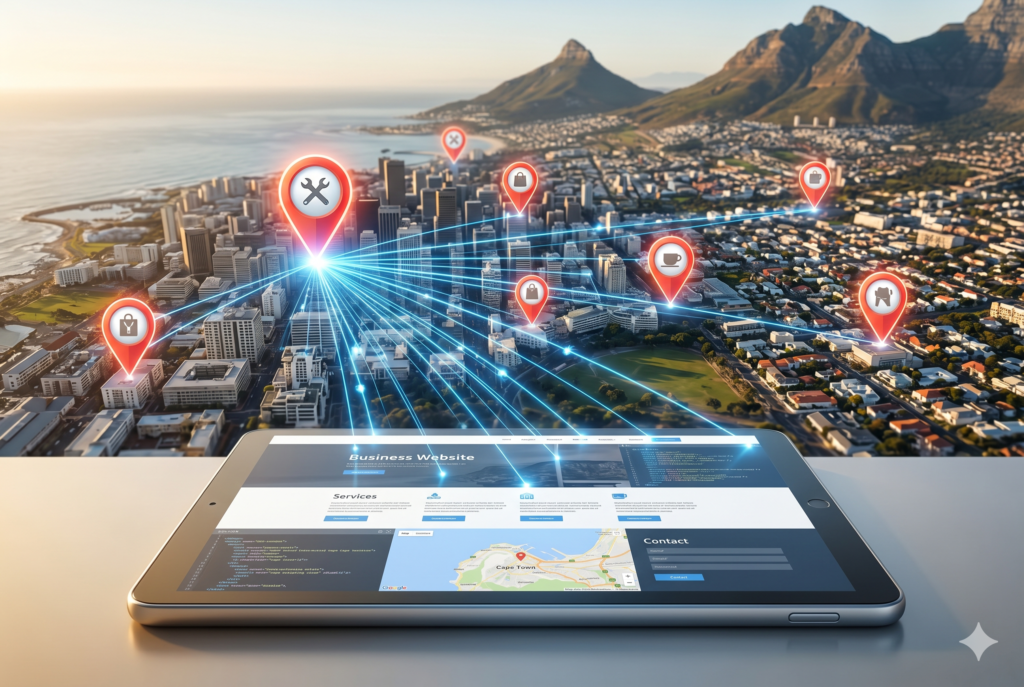
A website directly helps your business rank higher on Google Maps. While a Google Business Profile (GBP) is your primary asset for Map Pack visibility, Google’s algorithm cross-references your website to verify legitimacy, relevance, and authority.
A website provides the technical signals needed to support and amplify your GBP. Without it, you are at a significant competitive disadvantage in any market with active local competition.
The Technical Synergy: How a Website Influences Google Maps Rankings
A Google Business Profile does not operate in a vacuum. Google’s local algorithm is designed to answer a user’s query with the best possible business, right here, right now, by analysing a mix of signals. Your website is a powerful source of these signals, providing the data Google needs to trust and understand your business.
The connection is indirect but strong; your website works as a support layer for your GBP. It reinforces the services you offer, the areas you serve, and your overall trustworthiness. A weak, outdated, or technically poor website can stall Maps visibility, even if the GBP itself appears optimised.
Google Business Profile vs. Website: Primary Assets vs. Supporting Signals
Think of your GBP as the storefront sign and your website as the actual showroom. The GBP is the primary asset for immediate local visibility, designed to appear in Google’s Local Pack and Maps to provide users with quick, actionable information.
Your website is the supporting asset that provides long-term authority and deeper information, helping Google (and customers) choose you over a competitor.
- Google Business Profile: Your primary tool for local visibility. It provides essential data like operating hours, contact details, and reviews directly on the search results page.
- Website: Your credibility hub. It offers comprehensive service details, establishes your expertise, and provides the technical foundation for long-term SEO advantages.
The smartest strategy is not to choose one over the other but to integrate both. Your GBP captures high-intent local searchers, and your website converts them by providing detailed information and building trust.
Proximity, Relevance, and Prominence: Deconstructing the Local Map Pack Algorithm
Google’s local algorithm is built on three core pillars to determine which businesses appear in the coveted “Local 3-Pack”. Your website plays a critical role in signalling relevance and prominence.
Proximity (Distance)
This refers to how close your business is to the person searching. It is a dominant factor, and rankings can change significantly every few blocks. While you cannot change your physical address, a well-optimised website with clear location signals can help Google better understand your service area.
Relevance
Relevance is how well your business matches the user’s search query. Google analyses the primary and secondary categories in your GBP, the services you list, and, critically, the content on your website. Clear service pages with geo-specific keywords on your website reinforce to Google that you are a relevant match for local searches.
Prominence
Key signals for prominence include:
- Reviews: The quantity, quality, and recency of reviews on your GBP are crucial.
- Citations: Consistent Name, Address, and Phone number (NAP) details across reputable online directories.
- Website Authority: This is determined by factors like high-quality backlinks pointing to your site and its overall organic search performance.
Prominence measures how well-known and trusted your business is online and offline. This is where a website has a major impact.
Why Google Uses Your Website to Verify Business Legitimacy
Google’s core function is to provide trustworthy results. A website is a powerful signal of a legitimate, active business. Google cross-references the information on your GBP with your website to confirm consistency. Mismatched information, such as a different phone number or address, is a major red flag that can harm your visibility.
Verification is a foundational step for Google. By comparing your GBP data with your website, social media profiles, and online citations, Google builds confidence that your business is real and accurately represented. This trust is essential for ranking.
Can You Rank in the Local 3-Pack Without a Website?
Technically, yes, a Google Business Profile can rank in the Maps pack without a website. However, in any competitive market, businesses with well-optimised, locally relevant websites consistently outrank those without one. Relying solely on a GBP is a strategic limitation. It leaves long-term growth on the table and misses the opportunity to provide customers with in-depth information.
A competitor might rank without a website if they are physically closer to the searcher (proximity), have keywords in their business name, or have an older, well-reviewed GBP. But this is an exception, not a sustainable strategy.
The ~50/50 Rule: Traffic Distribution Between Maps and Organic Search
Data shows that for local searches; the Google Map Pack is the main event. Studies indicate that the Local 3-Pack captures between 40% and 50% of all clicks. One analysis found that 44% of local searchers clicked on the Map Pack results compared to just 29% for the standard organic results below.
This demonstrates that visibility in the Map Pack is critical for attracting high-intent local customers. Your website is a key tool for achieving that visibility by bolstering the authority and relevance signals of your GBP.
Strategic Limitations of Relying Solely on a Google Business Profile
While a GBP is powerful for immediate visibility, it has functional limits. You do not own your GBP listing; Google does. This means you have limited control over its features and are subject to policy changes.
Key limitations include:
- Limited Customisation: A GBP lacks the ability to feature detailed service explanations, case studies, or in-depth company information.
- No Long-Term Asset: Your website is an online property you fully control and build equity in over time.
- Reduced Conversion Power: A website provides the space to explain your services thoroughly, answer customer questions, and guide them towards a sale, which a simple profile cannot do.
Local Business Schema: Bridging the Gap Between Your Site and Maps
LocalBusiness schema is a specific type of structured data markup that you add to your website’s code. This code communicates essential business information like your name, address, phone number, and opening hours, to search engines in a standardised format that they can easily understand.
By implementing LocalBusiness schema, you remove ambiguity for search crawlers. This helps search engines accurately interpret your business details and match them to your GBP, reinforcing your legitimacy and improving your chances of appearing in the Local Pack for relevant searches.
Get a Technical Local SEO Audit
Your website and Google Business Profile must work in perfect sync. If your Maps performance has stalled, it is likely due to a technical disconnect between these two critical assets. We can analyse the algorithmic signals holding you back.
Get a no-obligation quote to identify the specific data points causing ranking issues. Let us run a diagnostic on your digital presence by clicking the button below.
FAQs
Is a website required to appear on Google Maps?
No, a website is not technically required. You can have a verified Google Business Profile without a linked website. However, in competitive markets, profiles without websites are at a significant disadvantage because they lack the authority and relevance signals that a website provides.
How does website content affect my Google Business Profile ranking?
Your website’s content helps Google determine your relevance and prominence. Location-specific service pages and detailed content confirm to Google what you do and where you do it, which directly supports the information in your GBP and helps you rank for more relevant local search queries.
Why is my competitor ranking higher on Maps without a website?
This could be due to several factors. The competitor might be physically closer to the location of the searcher, which is a very strong ranking signal. They may also have an older, more established GBP with a higher number of positive reviews, or their business name might perfectly match the search term.
What are the most important local ranking factors?
The three core pillars of local ranking are Proximity (how close you are to the searcher), Relevance (how well your business matches the search query), and Prominence (how well-known and trusted your business is). A strong website significantly boosts your signals for relevance and prominence.